

To grasp the value of using drone thermography for detecting PID, it’s crucial to contrast it with traditional methods, starting with the least effective: relying on production monitoring figures to detect PID’s effects.Generally speaking, PID manifests relatively slowly at first, with early stage production losses not being easily distinguishable from ordinary variations in module production. However, production losses increase dramatically as PID moves into more advanced stages and begins cascading to other modules in a string. So, significant production losses may already be baked in by the time that PID is identified using simple production monitoring.
Two other methods of detecting PID are reverse current electroluminescence (EL) testing and I-V curve tracing. While both of these methods are extremely reliable for detecting PID, even in its early stages, they are both extremely time and labor intensive, requiring individual PV modules to be disconnected and tested by highly qualified specialists under conditions that can be difficult to replicate in the field. As a result, it is generally cost prohibitive to apply these testing methods to more than a small sample of modules within a PV plant, which brings us to drone thermography.
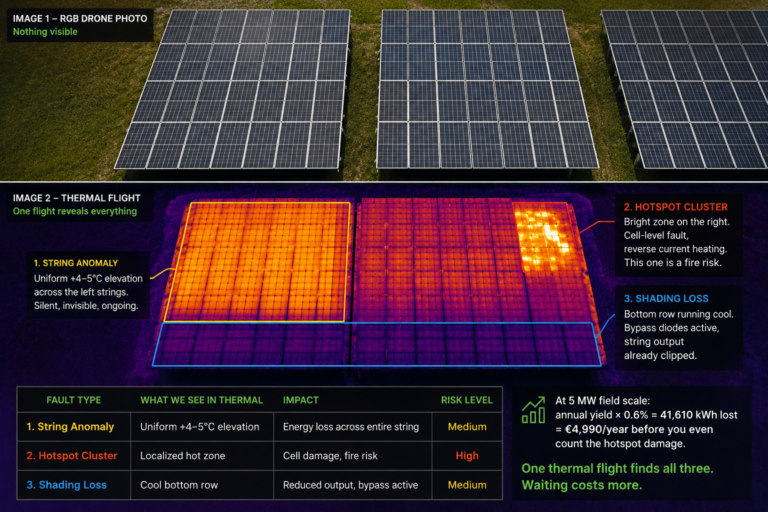
As most PV plant operators already know, many kinds of electrical malfunctions (including early stage PID) produce a thermal signature that may be apparent to an experienced thermographer without the need for invasive testing, system downtime, or exposure of technicians to hazardous voltages. Using drone thermography also allows data to be collected for entire sections of a solar plant simultaneously unlike handheld thermography, which requires module-by-module inspection.
Of course, drone detection of PID does have challenges. Since PID is itself imperfectly understood, there are only general patterns, no universal rules, for how it manifests on a thermographic image. For example, many instances of PID show up as thermal anomalies on the scale of individual cells or cause string end heating patterns.
While drone thermography may not always provide a definitive diagnosis of PID, it remains a valuable tool for swiftly scanning entire sites and identifying potential areas of concern. Given that other inspection methods can be labor-intensive and may not always detect PID, drone thermography offers a much more cost-effective means to locate modules possibly in the early stages of PID. By pinpointing these modules, operators can then proceed with further inspection using traditional methods such as EL testing and I-V curve tracing. This also means initiating manufacturer warranty claims, if necessary, becomes more feasible. This approach presents a more efficient alternative to randomly testing modules or passively awaiting advanced PID to manifest as production revenue losses.